1) Resistors
Resistor 1:
Color codes: red, red, orange, gold
Stated resistance value: 22000 ohms
Tolerance: ±5 %
Min/max possible resistance: 20900 / 23100 ohms
Actual measured resistance: 21970 ohms
Resistor 2:
Color codes: yellow, violet, orange, gold
Stated resistance value: 47000 ohms
Tolerance: ±5 %
Min/max possible resistance: 44650 / 49350 ohms
Actual measured resistance: 47200 ohms
Resistor 3
Color codes: red, red, orange, gold
Stated resistance value: 22000 ohms
Tolerance: ±5 %
Min/max possible resistance: 20900 / 23100 ohms
Actual measured resistance: 21750 ohms
2) Resistors in series
Resistor 1: 22000 ohms, 21970 ohms
Resistor 2: 47000 ohms, 47200 ohms
Resistor 3: 22000 ohms, 21750 ohms
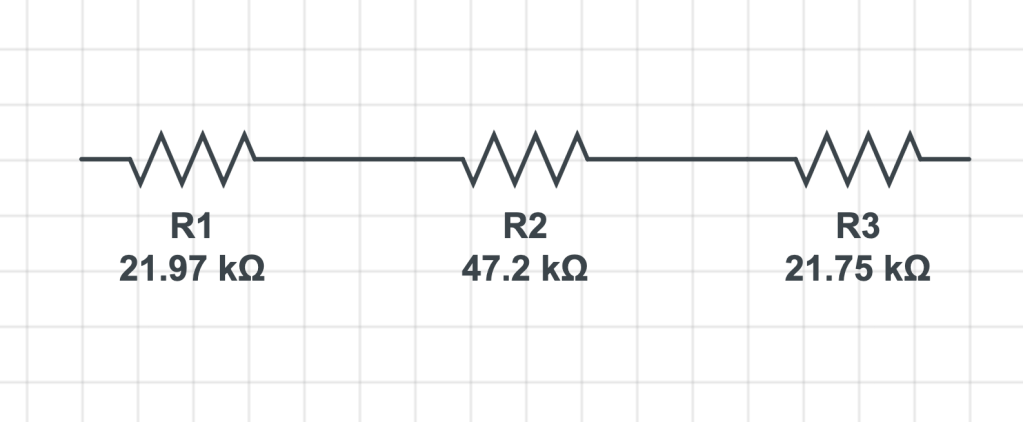
Calculated total resistance: 21.97 kΩ + 47.20 kΩ + 21.75 kΩ = 90.92 kΩ
Measured total resistance: 90.70 kΩ
3) Resistors in parallel
Resistor 1: 22000 ohms, 21970 ohms
Resistor 2: 47000 ohms, 47200 ohms
Resistor 3: 22000 ohms, 21750 ohms
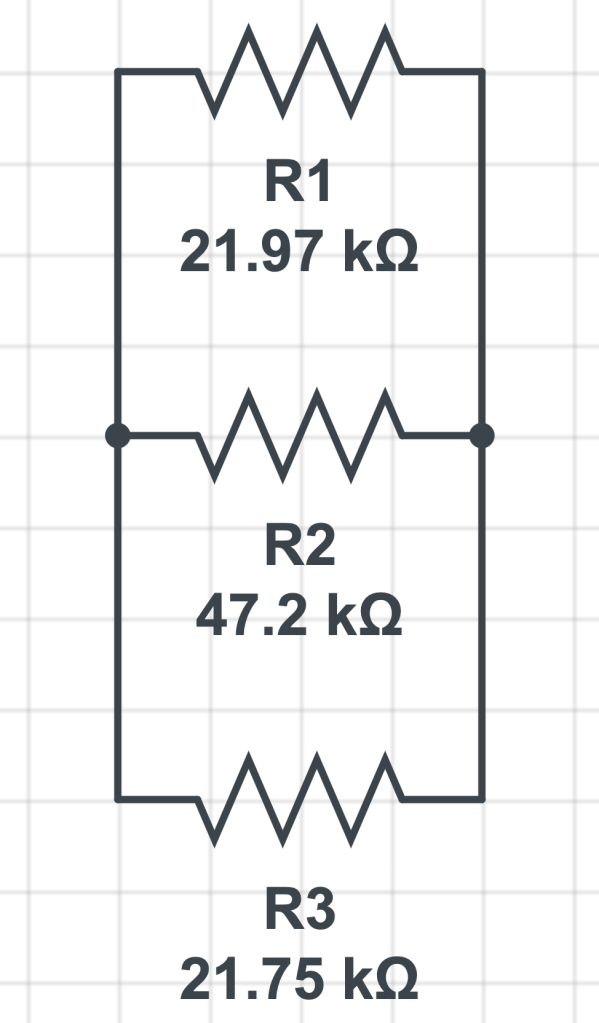
Calculated total resistance = 1 / ( (1 / 21.97 kΩ) + (1 / 47.2 kΩ) + (1 / 21.75 kΩ) )
= 8.87 kΩ
Measured total resistance = 8.85 kΩ
4) Voltage dividers
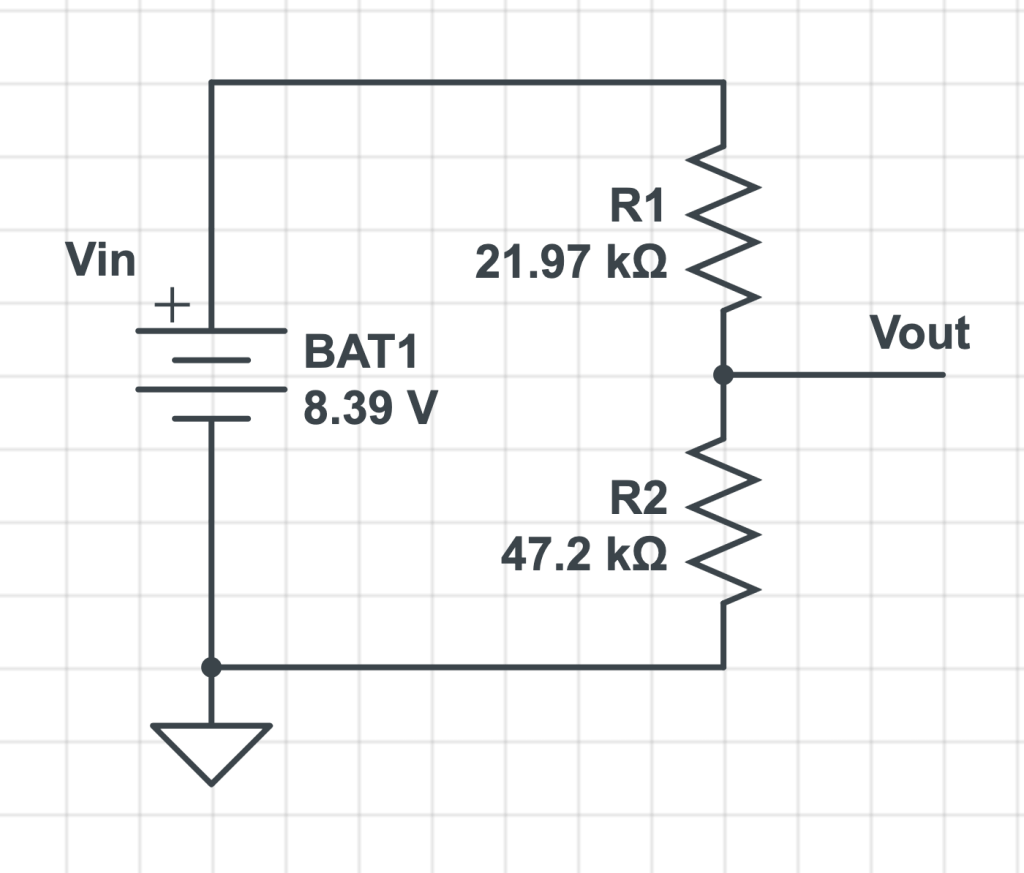
Calculated Vout: 8.39V * 47.2 kΩ / (21.97 kΩ + 47.2 kΩ) = 5.725 V
Measured Vout: 5.725 V
(I don’t know why the measured value matches the calculated value. I swear I actually measured it.)
5) Resistors in series and parallel
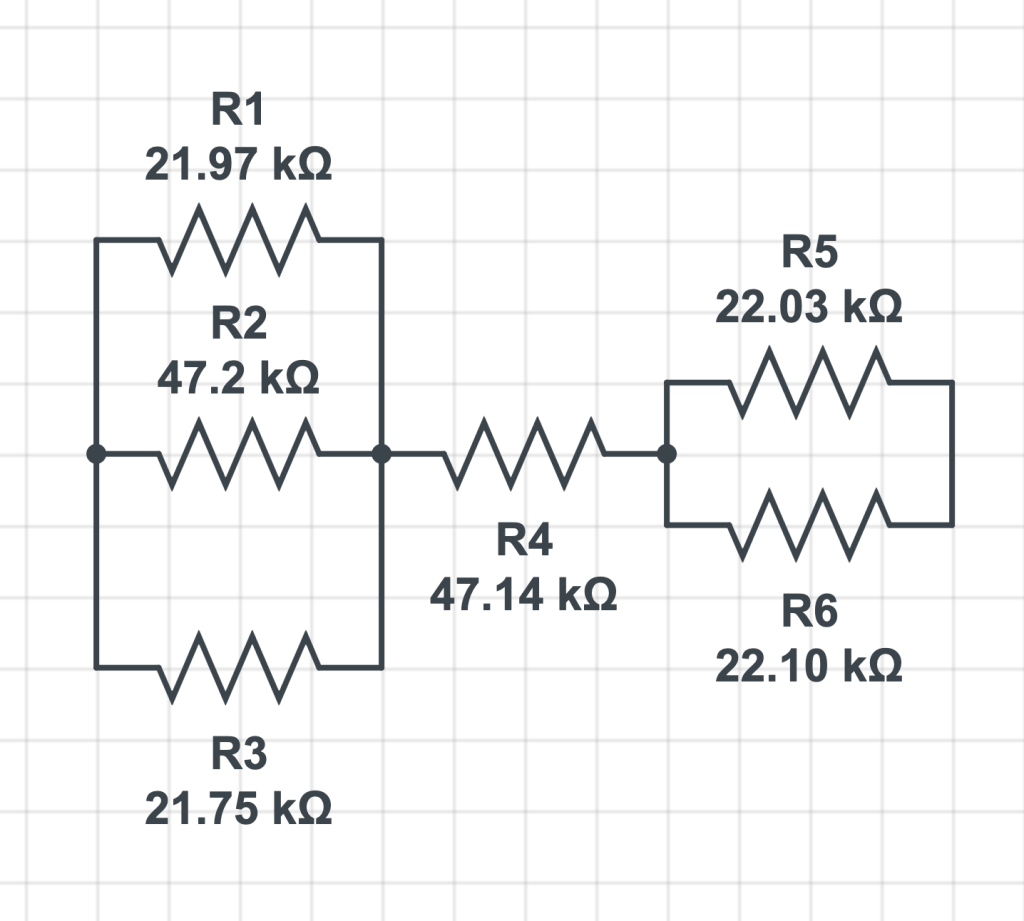
Calculated total resistance:
R1 + R2 + R3 = 1 / ( (1 / 21.97 kΩ) + (1 / 47.2 kΩ) + (1 / 21.75 kΩ) ) = 8.87 kΩ
R4 = 47.14 kΩ
R5 + R6 = 1 / ( (1 / 22.03 kΩ) + (1 / 22.10 kΩ)) = 11.03 kΩ
Total = 8.87 kΩ + 47.14 kΩ + 11.03 kΩ = 67.04 kΩ
Measured total resistance: 66.91 kΩ
6) Complicated resistor networks in voltage dividers
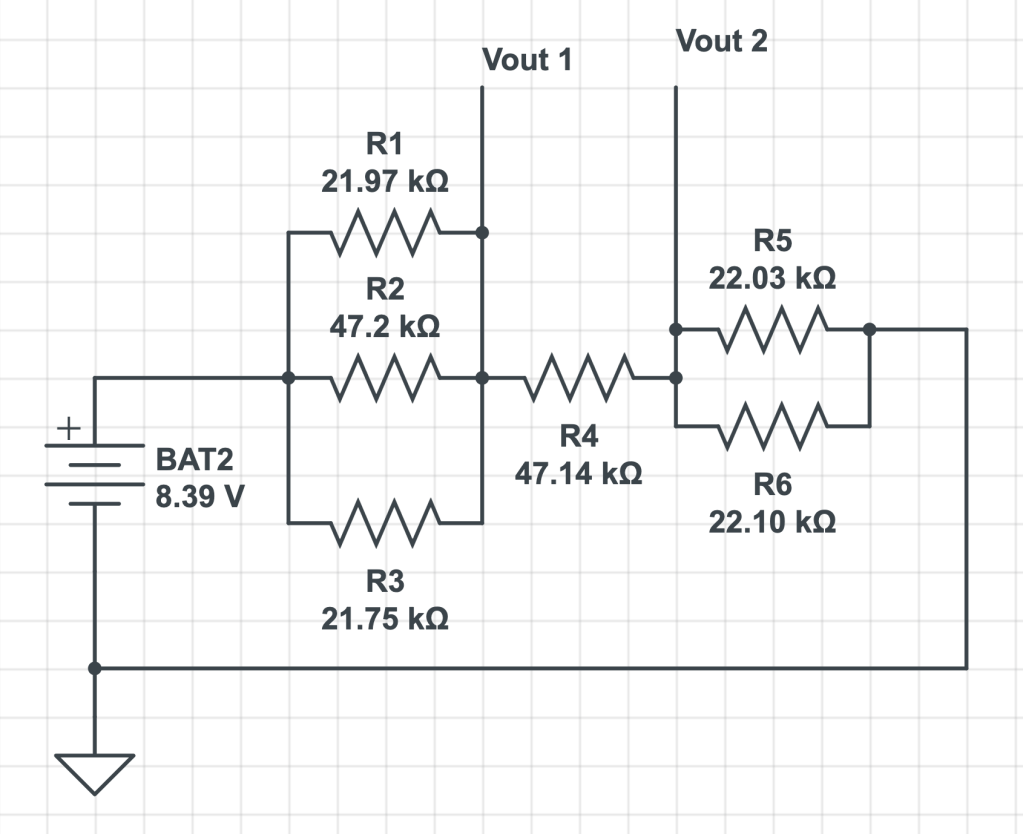
Calculated Vout 1:
R1 + R2 + R3 = 8.87 kΩ (as calculated above)
R4 + R5 + R6 = 67.04 kΩ – 8.87 kΩ = 58.17 kΩ
Vout 1 = 8.39 V * 58.17 kΩ / 67.04 kΩ = 7.72 V
Measured Vout 1: 7.02 V
Calculated Vout 2:
R5 + R6 = 11.03 kΩ
total resistance = 67.04 kΩ
Vout 2 = 8.39 V * 11.03 kΩ / 67.04 kΩ = 1.38 V
Measured Vout 2: 1.12 V
7) Kirchoff’s Voltage Law
Measured values:
Resistor 1: 21970 ohms
Resistor 2: 47200 ohms
Resistor 3: 21750 ohms
Vin: 8.39 V
V1 = 2.02 V
V2 = 4.35 V
V3 = 2.01 V
V1 + V2 + V3 = 8.38 V, approximate to 8.39 V
Calculated values:
V1 = 9 V * 22 kΩ / (22 kΩ + 47 kΩ + 22 kΩ) = 2.18 V
V2 = 9 V * 47 kΩ / (22 kΩ + 47 kΩ + 22 kΩ) = 4.65 V
V3 = 9 V * 22 kΩ / (22 kΩ + 47 kΩ + 22 kΩ) = 2.18 V
V1 + V2 + V3 = 9 V
Troubleshooting
When measuring the Vout, put one end of the multimeter at the Vout and the other end at the ground!!!! Don’t put the other end at the Vin.
 JERRY LIU ANALOG LAB REPORTS